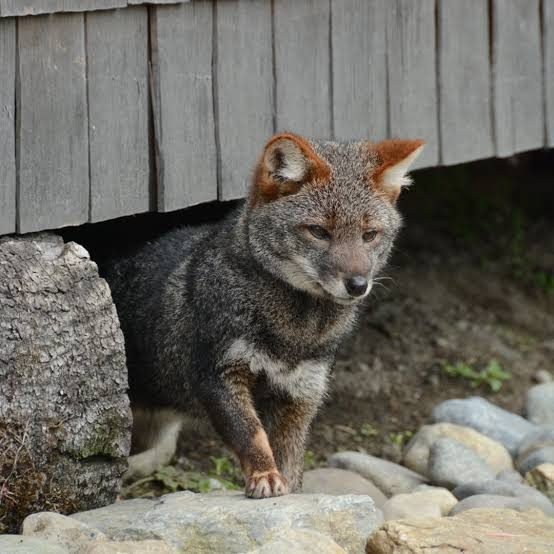
In December 1834, during the voyage of the Beagle, Charles Darwin collected a small dark fox on Chiloé that looked nothing like the mainland ones. More than a century and a half later, that same fox had a surprise in store: it also lived in the Nahuelbuta range.
## A different fox
**Darwin's fox** (*Lycalopex fulvipes*) is smaller and darker than the chilla or the culpeo. It weighs between 1.8 and 4 kg and has short legs, a broad head, grey and black fur with reddish tones, and a short, bushy tail.
For a long time it was thought to be a variety of the grey fox. DNA studies in 1996 confirmed it is **a species of its own**.
## From the island to the mountains
For more than 150 years it was believed to live only on Chiloé. In 1990 a population was confirmed in **Nahuelbuta National Park**, hundreds of kilometers from the island.
The most accepted explanation is that it's a **relic of the last ice age**: when sea levels were lower, Chiloé and the mainland were connected. As the ice retreated, the fox was left in two separate refuges. Today the Nahuelbuta and Chiloé populations differ by about 2% of their DNA.
## How many are left
The IUCN's 2016 assessment estimated about **639 adults** in total: around 412 on Chiloé and just **227 on the mainland**, almost all of them in and around Nahuelbuta. It is listed as **Endangered**.
## What threatens it
- **Free-roaming dogs**, which attack it and pass on diseases.
- **Forest loss**: the coastal range of La Araucanía lost forest at 4.8% a year between 1999 and 2008.
- Road kills, traps, and hunting when it's mistaken for feral dogs.
## How it lives
It's an opportunistic omnivore: it eats insects, small rodents, birds, reptiles, fruit and seeds. In Nahuelbuta it has been seen hunting forest mice and even the **monito del monte**. It's most active at dusk and before dawn, and it avoids areas with dogs.
## How to help when you hike
- **Don't bring dogs** to national parks or native forest.
- Don't leave food or trash: it teaches wildlife to approach people and roads.
- Drive slowly on park roads, especially at dusk.
- If you see one, stay still, don't follow it, and enjoy the moment.
Sightings are rare, but on our sunrise and sunset outings in Nahuelbuta we walk right through its territory, at the hours when it's most active.